
The Business Model layer enables you to model your business including business concepts in classes, class relationships, business logic, and workflows.
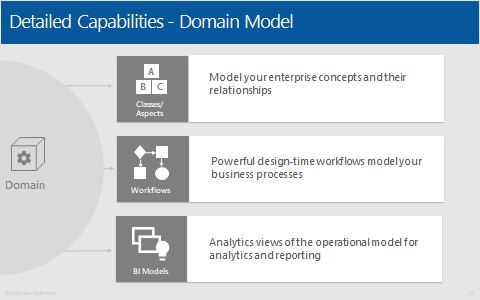
It is composed of structural components including:
Model Description Language Business Model Elements
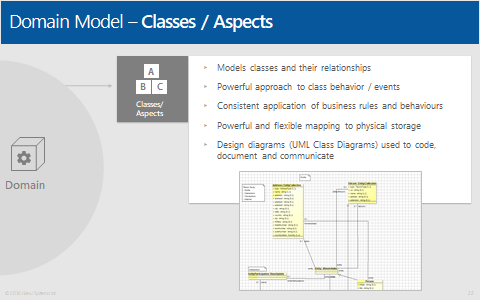
-
Classes - A Class is an abstraction of a business model concept
-
Aspects - Aspects are functional groupings of additional attributes and/or events that may be applied to your model
-
Augments - Augments contribute attributes and/or events or actions to a given class. They are used for modularization, i.e. separating the domain model into several modules without circular dependencies between them
-
Enumerations - Enumerations are a special type of Class that provide a list of values along with localizable captions
-
Diagrams - A UML Class Diagram editor for working with the model
Behavioural components including
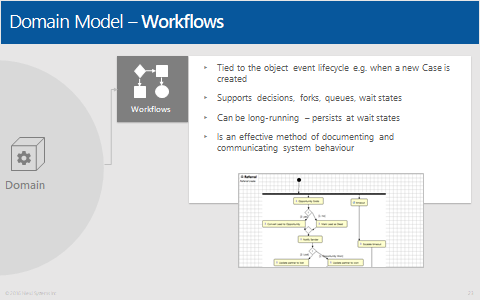
-
Rulesets - A set of rules to support run-time configurable business logic
Testing components including
-
Unit Tests - A set of test cases to test Model functionality
-
Test Suites - A grouping of unit tests for different test purposes
Other components including
-
BI Models - Simplified operational views for reporting - Deprecated:
-
Facets - A set of facets that can be applied to metadata objects